
Emergency Roof Repair Near Me: What Inglewood Homeowners Should Do First
The first thing to do after a roof emergency in Inglewood is not call a roofer. It’s protect yourself and your family, then document the damage, then control the water, and only then start making phone calls. If you’d rather skip the sequence and have a professional walk it with you, call (866) 361-1724 and we’ll talk you through it.
We get it. A tree limb through the shingles or a section of roof peeled back by Santa Ana winds sends most people straight to their phone. But the thirty minutes after the damage happens are when homeowners either protect themselves or quietly hand away thousands of dollars. Here’s what actually works.
The First 10 Minutes: Safety and Power
Right after a roof failure, two things need your attention before anything else: people and electricity. A wet ceiling doesn’t electrocute anyone by itself. But water running down through a ceiling and reaching a light fixture, a ceiling fan, or wiring in the attic is a fire hazard and a shock hazard.
Do this first:
- Move people and pets out of any room where water is coming through the ceiling. A waterlogged ceiling section can collapse. It’s heavier than you think, and it doesn’t give much warning.
- Kill power at the breaker box to any room with water penetration. Better to sit in a dark living room for a night than risk a short in a soaked junction box.
- Put a tarp, plastic sheeting, or a trash bag over furniture and electronics you can’t move. If you have a plastic storage bin or a five-gallon bucket, catch the water where it’s actively dripping.
- Don’t climb onto the roof at night or during wind. We say this as a roofing company that has watched homeowners do exactly that. A wet roof at night after a storm is how you end up with a broken leg on top of a damaged roof. Let us handle the ladder work once conditions are safer.
Most roof failures in Inglewood aren’t dramatic collapses. They’re slow leaks that show up as a stain or a drip hours after the rain stops or the wind dies down. The danger is that the water traveled along a truss or through insulation before it found a spot to drip, so the spot on your ceiling is rarely directly under the puncture in your roof. That matters for the next step, too.
10 to 30 Minutes: Document Before You Touch Anything
Here’s where Inglewood homeowners lose real money without realizing it. They see water coming in, they grab the garden hose or a tarp, and they start making “repairs” before they’ve taken a single photo. Then the insurance adjuster shows up and says: “You altered the scene. I can’t tell what the storm did versus what you did.”
Calling a roofer before you document can be one of the most expensive mistakes you make, and some contractors count on you making it. The good ones will tell you to photograph first, too.
What adjusters actually look for:
- Wide shots that show the whole roof plane or the whole ceiling, so the adjuster can establish context and scale.
- Close-ups of the failure point: the lifted shingle, the puncture, the displaced tile, the opened seam.
- Interior shots that show the water’s path: the stain on the ceiling, the wet drywall, the dripping point.
- Date-stamped images. Your phone already does this. Don’t edit or crop photos in a way that changes the file metadata.
- Screenshots of weather events if you can: the wind gust, the hail report, the heavy rain in your zip code. Inglewood sees less hail than the Valley or the foothills, but we get wind-driven rain and the occasional microburst, and adjusters appreciate corroborating weather data.
What smartphone photos typically miss: the roof edge, the flashing around chimneys or vents, and the underside view from inside the attic. If you can safely access your attic with a flashlight, photograph the underside of the decking where the water came through. That tells the adjuster the leak isn’t a pre-existing stain you ignored for six months.
Take photos before you move the couch. Take photos before you poke the wet drywall. Take photos before you put the bucket down. Then take a few more after, so the insurance company can see the steps you took to limit further damage. That’s the part insurers actually want to see: a homeowner who took reasonable steps to mitigate.
30 to 60 Minutes: Control the Water Without Destroying Evidence
Once you’ve documented, your job is to stop the water from doing more damage, not to fix the roof. Temporary water control looks different from permanent repair, and confusing the two is another common mistake.
Effective temporary measures:
- Interior catch containers under active drips. Empty them before you go to bed.
- A tarp placed from inside the attic, if you can reach the leak point safely from the attic access. This keeps water from traveling through insulation and finding a new exit.
- Gently popping a small hole in a bulging ceiling stain to let water drain into a bucket. We know, it sounds counterintuitive to make a hole. But releasing the weight of trapped water can prevent a larger section of drywall from tearing loose. Use a screwdriver, stand to the side, and have a bucket directly underneath.
- Shutting off the water supply if the “leak” might be plumbing-related rather than roof-related. In Inglewood’s older housing stock near the downtown core and Morningside Park, we’ve seen more than one “roof leak” that turned out to be a crack in an old galvanized supply line or a failed water heater in an attic space. If the drip is steady even when it’s not raining, or the water is warm, call a plumber instead of us.
If you can’t safely reach the roof or the attic, don’t. A ceiling stain spreads slowly. An injury doesn’t. Your insurance claim will still be valid tomorrow.
The Tarp Question: What to Ask Before You Accept an Emergency Tarp
Storm-chasers know that a damaged roof is a sales opportunity with a countdown clock. They’ll offer to tarp your roof the same night “to protect your home,” and some will do a decent job. But the tarp conversation is where you need to be most clear-eyed, because accepting a contractor’s tarp can complicate your claim.
Here’s what to ask before you let anyone on your roof:
- “Is this tarp included with the repair estimate, or billed separately?” Some storm-chasers bill $800 to $1,500 for a tarp that takes an hour and $90 in materials, then fold that cost into a padded replacement quote. A legitimate roofer in Inglewood will tell you the tarp cost up front and line-item it.
- “Will you write a letter for my insurance company describing what you saw and what you did?” This is huge. A roofer who will put their name on a scope-of-damage letter gives your adjuster a professional account of the failure point. A storm-chaser who won’t is usually trying to avoid a paper trail.
- “What did you actually see up there?” This question reveals more than any license lookup. We’ve heard every answer: “Needs a full replacement,” “Tore the whole thing up,” “Looks bad up there.” A real answer sounds different: “The flashing pulled away at the valley near the chimney, and three felt seams are open about four feet back from the rake edge.” Specifics mean someone actually looked. Generalities mean someone is selling.
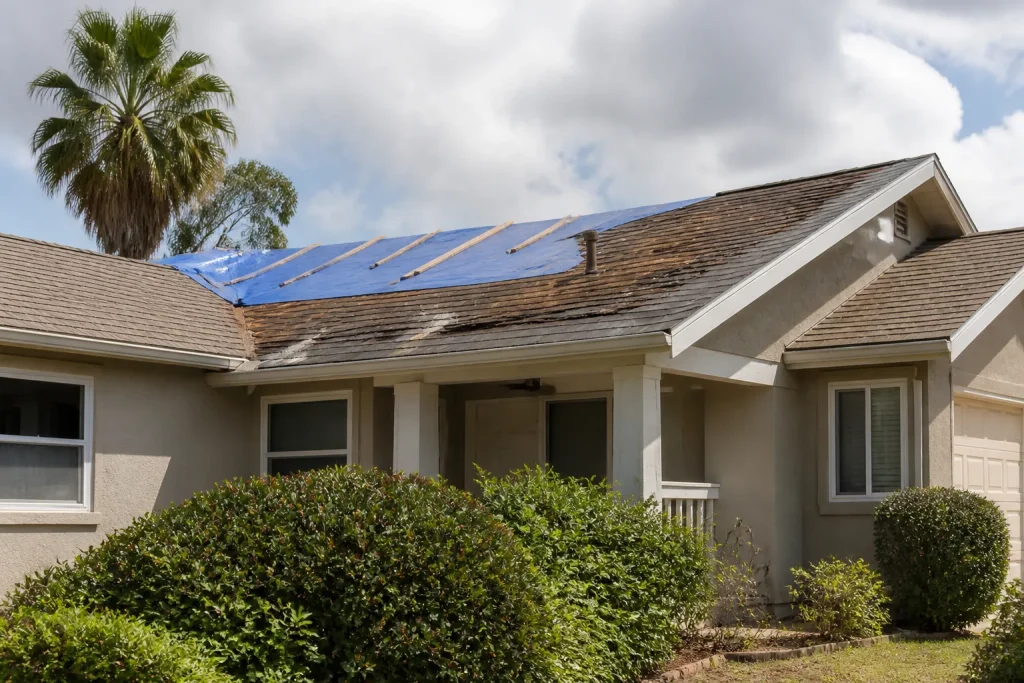
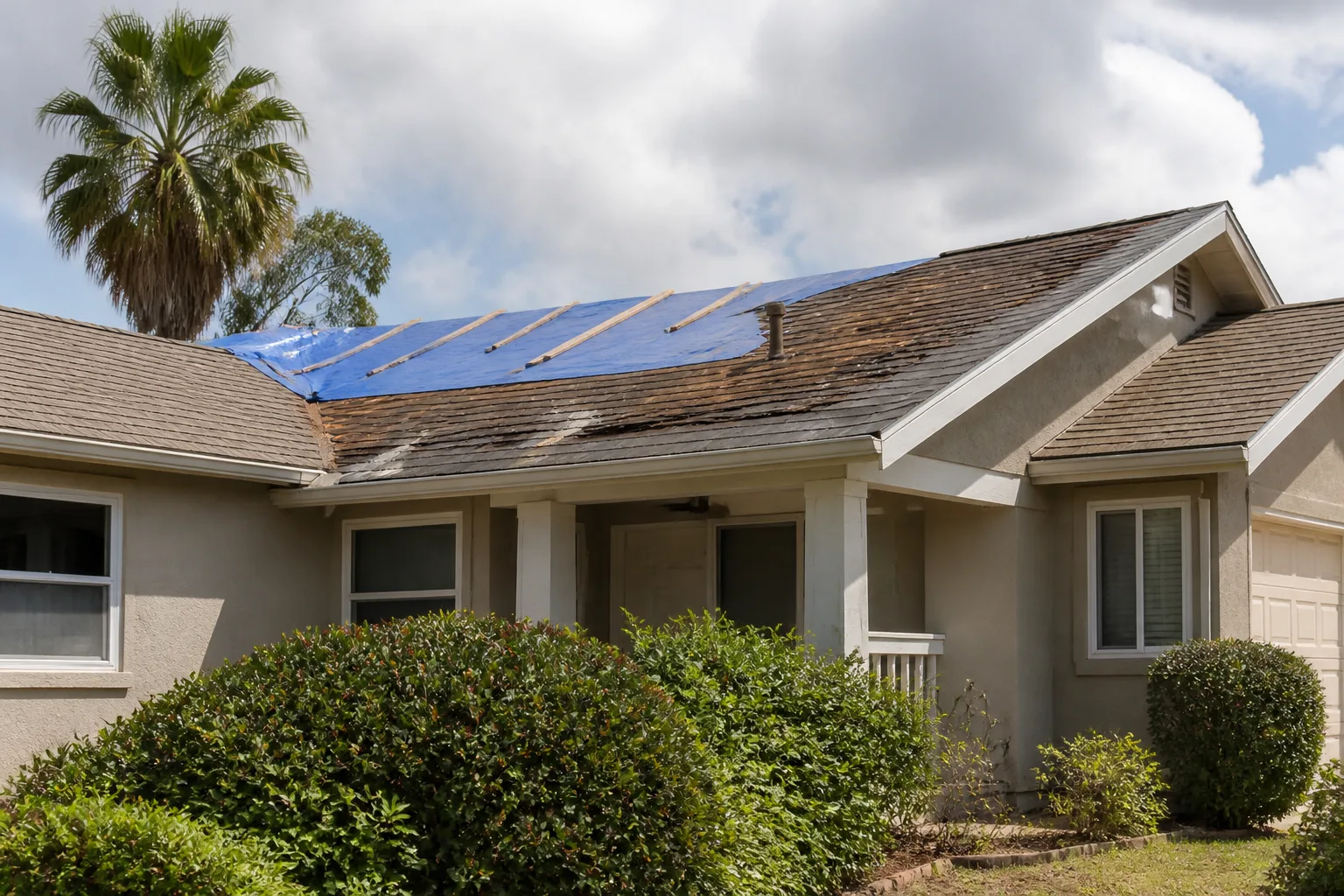
Tarps are a legitimate, necessary tool. We use them constantly after storms. But a tarp is not a repair, and it’s not a contract. If a roofer pressures you to sign a full replacement contract before they’ll leave the tarp on, call someone else.
What Inglewood’s Post-Storm Response Window Actually Looks Like
When a storm front moves through South LA County, every roofing company within thirty miles gets the same flood of calls. Inglewood’s post-storm response window typically runs two to five days for non-emergency inspections and same-day to next-day for active water intrusion, depending on the severity of the storm and how many homes took damage.
So what do you do when no one can get out until Thursday, and it’s Monday night?
If you have active water coming in: follow the interior control steps above, keep documenting, and ask any roofer you call whether they have a cancellation list. Ask whether they can send someone to tarp before a full inspection. And be willing to field calls from established local companies over regional storm-chasers who chase every weather event from Texas to Bakersfield and won’t be around if the repair fails in two years.
If your leak is slow or the roof looks damaged but hasn’t opened up: you probably have more time than you think. A lifted shingle doesn’t mean the roof is about to peel off. We’ve told plenty of Inglewood homeowners in the La Tijera corridor and down near Darby Park that a small wind-lift could wait until we could inspect it properly, as long as the weather held. Sometimes the honest answer is “you can wait.” A contractor who tells you that has probably earned your next inspection.
While you wait, avoid DIY fixes that make the real repair harder: no caulk on shingles, no spray sealant on a pipe boot you can’t identify, no opening up the roof surface. Those temporary “fixes” add hours to the proper repair when we have to undo them first.
How to Pick a Legitimate Emergency Roofer in Inglewood
Three phone questions separate the real roofers from the storm-chasers. We recommend every Inglewood homeowner ask them before saying yes to anyone:
- “Do you have a local crew, or subcontractors traveling with the storm?” A real local company sends people who live in or near Inglewood. A storm-chaser imports sales crews and sometimes subcontracted labor from out of state, and they’re gone by the time problems show up.
- “Will you show me the damage in photos from the roof while you’re up there?” Any legitimate roofer will. We take photos on every inspection and walk homeowners through them, pointing out exactly what we’re seeing. If a company won’t show you the damage, presume there’s no damage, and that’s precisely why they don’t want you to see the photos.
- “If the repair fails in a year, who handles the warranty?” If the company can’t answer that confidently and point to a local presence, you’re not hiring a roofer. You’re renting a sales crew.
At Chatham Roof Repair, we’re a roofing-only company. We don’t do siding, gutters, or windows; we don’t spread our attention across a dozen trades. That focus matters in an emergency because the person who arrives at your door actually understands roof systems: how water travels through decking, how flashing fails at the transition points, why certain materials work differently under Inglewood’s sun exposure and marine-layer mornings. We also carry products from seven major manufacturers, including Atlas and Tamko, which lets us match a repair to your existing roof profile rather than whatever we happen to have on the truck. For a full picture of how we approach repairs in Inglewood, see our Roof Repair in Inglewood page.
One more note on the storm-chaser topic. We pulled a tarp off a house over in the Morningside Park neighborhood last year where a “roofer” had secured it with sixteen deck screws driven through the shingles and into the underlayment. The homeowner paid $1,100 for that tarp. The actual repair cost doubled because we had to undo the damage the tarp caused before we could fix the original leak. Sixteen screws. Write that down as the most expensive “temporary protection” you’ll ever see.
When to Call a Pro
You should call a professional roofer anytime a roof leak has penetrated the interior, whenever you see daylight through the roof decking from inside the attic, or when shingles, tiles, or flashing are visibly displaced after wind or impact. If you’re unsure whether the damage is cosmetic or structural, that’s exactly what a Roof Inspection in Inglewood is for. We tell plenty of homeowners the roof can wait, and sometimes the honest answer is that it can’t.
Never climb onto a roof you can’t safely inspect from a ladder braced on level ground, and never attempt repairs on steep pitches, wet surfaces, or damaged decking. Those are the jobs that put people in emergency rooms. If your roof has opened up and water is coming through, call us and we’ll talk through your next move from the ground while you stay off the ladder.
The Bottom Line
The half hour after a roof emergency is not about fixing the roof. It’s about preserving your safety, your evidence, and your insurance claim, in that order. Move people out of wet rooms, cut power where water meets wiring, photograph everything before you move anything, control water with buckets and an interior tarp, and ask any roofer who shows up the three questions that separate a local professional from a storm-chaser.
If you’re in Inglewood and want a straight assessment of what your roof actually needs, Chatham Roof Repair offers free estimates. We look for the repair before we recommend a Roof Replacement in Inglewood, and we’ll show you the damage in photos before we quote you a dollar. Call (866) 361-1724 and we’ll talk you through it.
For more on how we approach the full lifecycle of roof care, start at the Chatham Roof Repair home page.
Frequently Asked Questions
Emergency roof repair in Inglewood typically runs $350 to $850 for tarping and temporary water control, and $450 to $1,800 for permanent repairs to flashing, shingles, or small decking sections, depending on access and materials. The biggest cost variable is whether the damage is a single point of failure or a wider section that requires material matching. Call (866) 361-1724 for an exact quote after an inspection. Estimates are free.
In most cases, yes: temporary tarping to prevent further damage is a standard covered mitigation expense under most homeowners policies. What matters is documentation. Keep the roofer’s written scope-of-damage letter showing what they saw, what they did, and when. Submit that letter with your claim. Without it, the insurer may dispute whether the tarp was necessary. Any roofer who won’t write that letter is not someone you want on your roof.
A properly installed tarp can stay in place for 60 to 90 days without causing damage, as long as it’s secured correctly and inspected after high winds. Problems start when a tarp is screwed through shingles, left to flap in Santa Ana winds, or left through Inglewood’s damp marine-layer season, which can trap moisture against the decking. The tarp is temporary. The repair should be scheduled as soon as the weather and contractor availability allow.
You can catch water and slow the spread, but you should not attempt a roof repair from the ground or without proper training, especially on a wet or steep roof. Most DIY roof fixes fail at the flashing points or the underlayment transitions, which are exactly where real leaks happen. We’ve seen homeowners spend $60 on sealant and make the actual repair twice as expensive. If you’re in Inglewood and need a straight answer about what you’re looking at, call (866) 361-1724. We’d rather tell you it’s minor than watch you risk a ladder.
Written by the team at Chatham Roof Repair, serving Inglewood since 2016.
Need Roofing Help?
Call Chatham Roof Repair — licensed & insured, here with fast after-hours help in Inglewood.
(866) 361-1724