IKO Roof Repair in Inglewood: A Homeowner’s Guide
IKO roof repair in Inglewood comes down to one thing most homeowners never hear about until it’s too late: material matching. Get the wrong shingle on an IKO roof and you’ve created a warranty void and an eyesore in one trip up the ladder. The fix usually costs between $350 and $900 for a standard repair, but that number swings hard depending on which IKO product line you have and when it was installed. If you’d rather skip the detective work, call (866) 361-1724 and we’ll sort it out.
If a roofer shows up to repair your IKO roof and pulls generic contractor-grade shingles off their truck without asking which IKO line you have, your warranty is likely voided before they’ve driven the first nail. That’s the opening hook because it’s the single most common mistake we see on IKO repairs across Inglewood. Homeowners assume a shingle is a shingle. It isn’t. IKO makes at least seven distinct residential lines, and they don’t interchange.
We’ve repaired hundreds of IKO roofs from Morningside Park to the neighborhoods off Century Boulevard, and the pattern holds: the roofs that fail twice are the ones where someone guessed at the product line the first time. This guide covers what actually matters for IKO roof repair in Inglewood: identifying your shingle line, understanding granule matching under Southern California sun, knowing the failure points in Santa Ana wind, verifying genuine materials, and deciding whether repair or replacement makes sense.
How to Identify Your IKO Product Line (and Why It Matters)
Before anyone touches your roof, you need to know exactly which IKO shingle you have. The product line determines dimensional profile, granule color availability, and which warranty terms apply. Guess wrong and the repair won’t seat properly, won’t match, and won’t be covered.
The three most common IKO lines we see on Inglewood homes:
- IKO Cambridge – An architectural laminate shingle. This is the most common IKO line in Southern California by a wide margin. Installed on homes built or re-roofed from roughly 2005 through today. Available in a wide color range, but IKO has shifted some colorways over the years, which matters more than people think.
- IKO Dynasty – A heavier architectural shingle with a more pronounced profile. Owners often mistake it for Cambridge because they look similar at a glance. They are not interchangeable. Dynasty sits differently on the roof deck and the shadow line doesn’t match.
- IKO Nordic – A premium architectural shingle with a distinct dimensional look, often paired with higher wind ratings. Less common in Inglewood but present in higher-end neighborhoods north of the 405.
Older Inglewood homes may also have IKO Marathon or IKO SuperView lines that are now discontinued, and that’s where repair gets tricky. Discontinued lines mean no new stock from the manufacturer. The only path to a clean repair is sourcing matching material from a roofer who keeps multi-brand inventory, or accepting a close-but-not-exact match. We keep a broad inventory across seven manufacturers, including IKO, specifically so discontinued-line repairs don’t strand homeowners.
The practical step is simple: check the paperwork from when your roof was installed, look for a bundle wrapper in the attic or crawlspace, or pull up a production photo. If none of that exists, a competent roofer can identify the line from the roof deck by width, exposure, and profile. Just make sure they actually look.
Granule Matching in Inglewood Sun: What “Close Enough” Costs You
IKO shingles fade in the Inglewood sun. They all do. The question is how much, how fast, and what that means when you repair a section rather than replace the whole roof.
Granule loss follows a predictable curve here. On south-facing and west-facing slopes, IKO shingles start showing visible granule wear between years four and seven. The color softens, the surface texture changes, and if you hold a brand-new bundle wrapper up to the same colorway, the difference is obvious. North-facing slopes hold color longer, sometimes a decade or more before a mismatch is noticeable.
When a roofer tries to match a repair patch to a six-year-old IKO roof by grabbing the current color-code shingle, the patch reads as a lighter rectangle from the street. Homeowners call it a “repair tattoo.” Appraisers notice it. Buyers notice it. A repair that saves $200 today can knock $2,000 off perceived value at resale.
The honest options, in order of cost:
- Exact-match stock from the same era – Rare, requires a roofer with deep or multi-brand inventory. This is the gold standard for a repair that disappears.
- Current-product match with oxidation consideration – A good roofer can sometimes source a current color that’s actually darker or deeper than the original, so it blends as the repair ages into the sun-exposed roof. This works surprisingly well on IKO Cambridge in Driftwood and Weatherwood tones.
- Re-roof the affected plane – On smaller roof planes or garage slopes, replacing all shingles on that single plane with current stock sometimes makes more sense than patching.
What we tell Inglewood IKO owners is this: the repair needs to match in profile, color family, and ideally era. “Close enough” is a decision, not an accident.
IKO Failure Points We See in Inglewood: Starter Strips and Ridge Caps
IKO shingles themselves hold up reasonably well in coastal climates when installed correctly. The failures we chase most often in Inglewood are not the shingles failing, but the components around them.
Santa Ana wind conditions put a specific load on roof edges and hips. We see two failure patterns consistently:
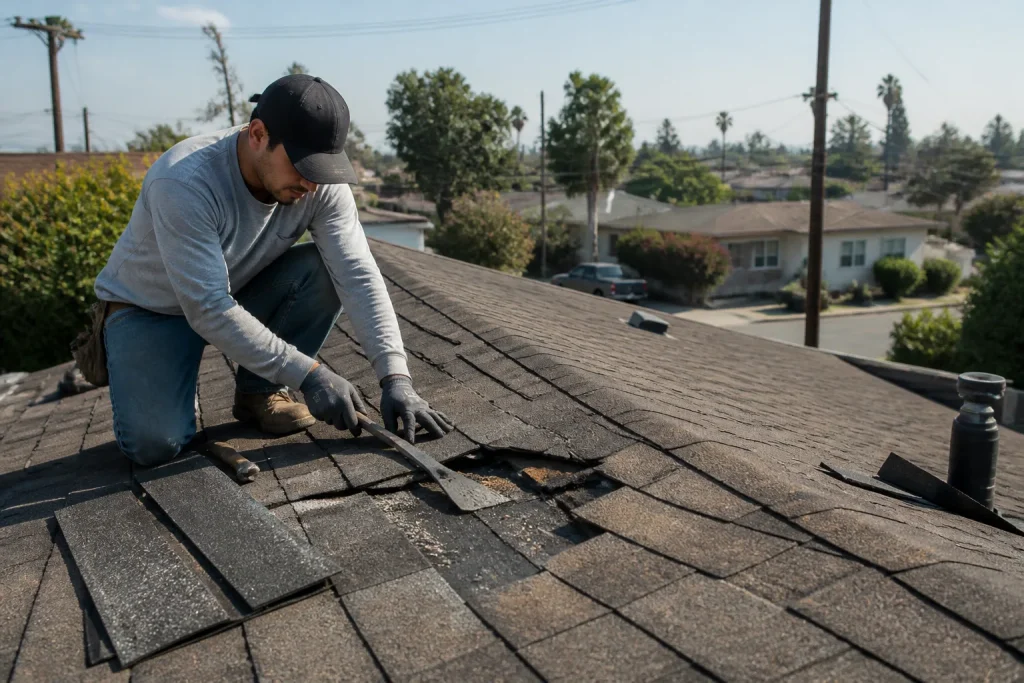
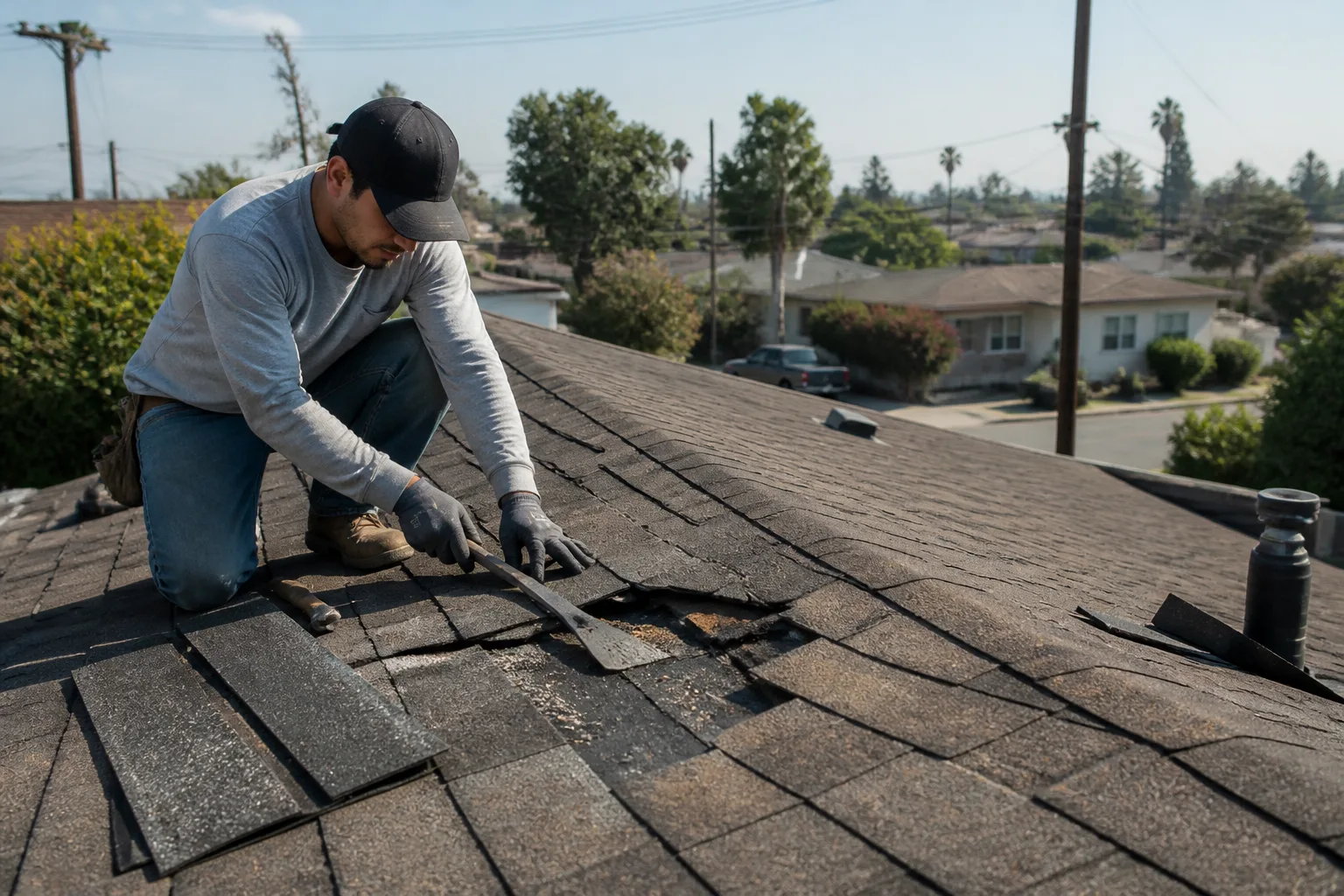
- Starter strip adhesion loss – The first course of shingles, the one that seals the eave edge, pulls up when the starter strip underneath was nailed incorrectly or the adhesive strip never bonded. IKO’s high-wind installation spec calls for specific starter placement, and when a previous crew skipped it, the bottom edge of the roof starts flapping in September and October winds. The repair is straightforward but the cause often goes undiagnosed because it requires lifting the first course to inspect.
- Hip and ridge cap lifting – Ridge cap shingles take wind from both sides and they’re the first thing to lift in the higher gusts that come through the Inglewood hills and the flats off La Brea. On IKO roofs, we frequently find ridge caps that were installed with standard nails where high-wind fastening was required, or that simply aged out of their adhesive bond.
Neither of these is an IKO defect. They’re installation and environment issues. But they matter because a roofer who only looks at the field of the roof and not the edges will miss both, and you’ll be back on the phone after the next wind event.
Warranty Transfer and Repair Documentation: The Part Everyone Skips
IKO’s warranty structure has specific requirements around repairs and transfers, and most contractors don’t bring them up until the work is done. By then it’s too late to fix the paperwork.
Here’s what Inglewood IKO owners need to know:
- Repairs must be documented to preserve coverage. If you make a repair and don’t have a written record of what was done, what material was used, and who did it, the manufacturer can deny a later warranty claim on that area. A receipt that says “roof repair” isn’t sufficient.
- Warranty transfer is not automatic. IKO’s limited warranties have a transfer window after a home sale, typically within 30 to 60 days, and require a transfer application. Miss the window and the warranty reverts to a reduced term or terminates. We’ve walked Inglewood homeowners through this after they bought a house with a five-year-old IKO roof and no transferred coverage.
- Non-genuine repair materials void the relevant warranty section. If a roofer patches your IKO roof with a different manufacturer’s shingle, that area loses coverage. This is the single most common warranty issue we see, and it’s entirely avoidable.
The practical takeaway: when you have any IKO roof work done, ask for a line-item description of materials used and a written confirmation that genuine IKO product was installed. If the roofer can’t provide that, find another roofer.
How to Verify Genuine IKO Repair Materials
This is the section that separates a real repair from a cheap patch, and it’s the reason we hear from Inglewood homeowners after a bad experience with another contractor.
Genuine IKO shingles are easy to verify if you know what to look for, and most visually similar products fail the test quickly.
Here’s the checklist we use on every IKO repair:
- Bundle wrappers. Every genuine IKO bundle has a wrapper with the product name, the color code, and the manufacturing plant location. Ask to see the wrapper before the crew opens it. If the roofer shows up with unmarked bundles or bags of loose shingles, that’s a red flag.
- Product line on the wrapper. The wrapper must state Cambridge, Dynasty, Nordic, or whatever line is being installed. “Architectural shingle” written in marker is not the same thing.
- Color code matching. IKO color codes are printed on the wrapper. Match the code, not just the color name. Color names change over time; codes are the reliable identifier.
- Tear-off patch count. A real repair uses a specific number of shingles per square. If the crew didn’t bring at least one full bundle for even a small repair, they’re improvising.
We’ve pulled one out of a garage over near Inglewood Park Cemetery last month where the previous roofer had used a Three-Tab shingle to patch an IKO Dynasty roof. The profile was wrong, the color was wrong, and the homeowner had paid $450 for the privilege. The repair failed in the same season. Genuine materials are not a premium add-on; they’re the entire job.
One more thing worth knowing: several manufacturers make architectural shingles that look close to IKO at driveway distance. Atlas and Owens Corning both have lines in similar color families. They’re good products. They are not interchangeable with IKO for warranty purposes, and the dimensional profile is just different enough to show at the edges. If your roofer proposes a “compatible” product, ask them to put the compatibility claim on the written quote. Most won’t, because the manufacturer wouldn’t back it.
For IKO roofs specifically, we always stock current Cambridge and Dynasty colorways, and we have access to older stock through our multi-brand inventory channels. That’s not a brag; it’s the difference between a repair that disappears and one you see every time you pull into the driveway.
When to Repair vs. Replace an IKO Roof in Inglewood
The repair-versus-replace decision on an IKO roof follows a logic we apply to every brand, but the IKO specifics matter here.
Repair makes sense when:
- The roof is under 10 years old and the damage is localized: one section lifted by wind, a branch strike, flashing failure around a penetration.
- The IKO product line is still in production and material matching is clean.
- The roof structure and underlayment are sound, and inspection confirms the field shingles still have meaningful service life.
Replacement makes more sense when:
- The roof is approaching or past 15 years on IKO Cambridge or Dynasty, especially with visible granule loss on multiple slopes.
- The original line is discontinued and the damage covers more than 15 to 20 percent of the roof area.
- Previous repairs were done with mismatched material, so the roof is now a patchwork that won’t match no matter what you do.
Inglewood’s roof age mix is broad. We work on 1920s bungalows off Centinela, 1960s ranch homes in the avenues, and newer builds near the Forum. The right call depends on the roof, not the neighborhood, but the honest answer is usually visible from the ground once you know what to look for. If you’re not sure where your roof falls, Roof Inspection in Inglewood is where we start: a documented look at the roof system, so you know whether you’re pricing a repair or planning a replacement.
The Bottom Line
IKO roof repair in Inglewood is not complicated if three things happen: the product line is identified correctly, genuine IKO materials are installed, and the work is documented for warranty purposes. Skip any one of those and the repair either fails or costs you coverage you didn’t know you were losing.
The practical steps: identify your IKO line, check your warranty transfer status if you bought the house recently, ask to see bundle wrappers before work starts, and get the repair documented in writing. Then decide whether the roof is a candidate for repair or whether the condition of the whole system says it’s time for Roof Replacement in Inglewood.
If you’re in Inglewood and need help with an IKO roof, Roof Repair in Inglewood is what we do every week. Chatham Roof Repair offers free estimates, and we’ll tell you straight whether you need a patch or a plan. Call (866) 361-1724 to schedule.
Frequently Asked Questions
IKO roof repair in Inglewood typically runs $350 to $900 for a standard localized repair. The range depends on the IKO product line, whether the line is still manufactured, and whether the damage is isolated to the field, flashing, or ridge. Discontinued lines can push the cost higher because matching material is harder to source. Call (866) 361-1724 for an exact quote; estimates are free.
Any licensed roofer can physically install shingles on an IKO roof, but not every roofer can do it correctly. The roofer needs to identify the exact IKO product line, source genuine IKO material in the correct color code, and document the work for warranty purposes. A roofer who doesn’t do these three things can void your warranty and leave you with a visible mismatch.
Not with us. We quote from the roof, not from the driveway, and the number on the written estimate is the number you pay. If inspection during the repair reveals something hidden, we stop, show you what we found, and agree on any change before proceeding. No change orders slipped in at the end.
Most IKO roof repairs in Inglewood are completed in a half day to a full day, depending on the size of the repair and whether we’re matching discontinued material. The material sourcing can take longer than the installation when the product line is older. We’ll tell you the timeline up front, before you commit.
In Inglewood, small-scale roof repairs generally don’t require a permit, but anything structural or covering a large percentage of the roof does. We pull permits when they’re required and handle the inspection process. You’ll know before the work starts whether your repair falls under the permit threshold.
Still reading because you’re not sure which IKO line is on your roof? Start with Chatham Roof Repair home and give us a call. We’ll come take a look.
Written by the team at Chatham Roof Repair, serving Inglewood since 2016.
Need Roofing Help?
Call Chatham Roof Repair — licensed & insured, here with fast after-hours help in Inglewood.
(866) 361-1724