Last updated October 30, 2026
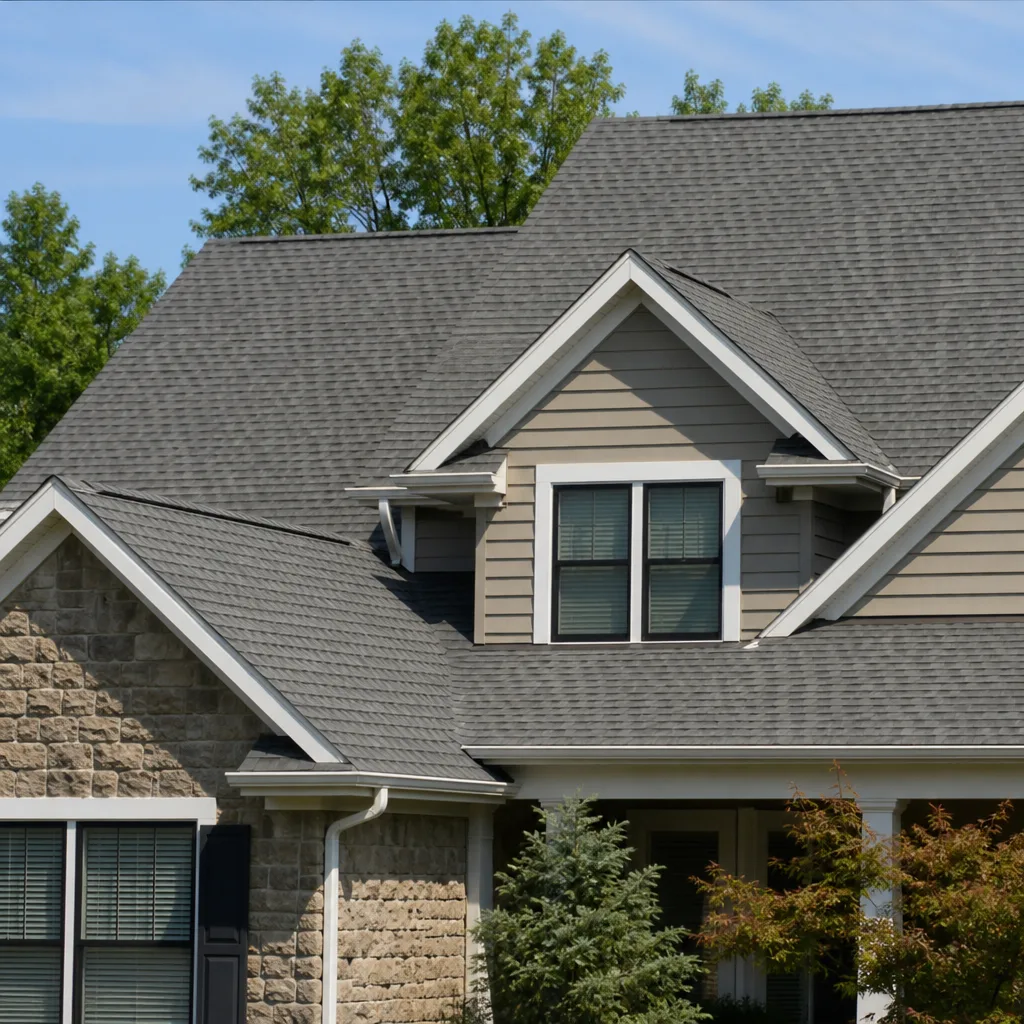 Architectural shingles
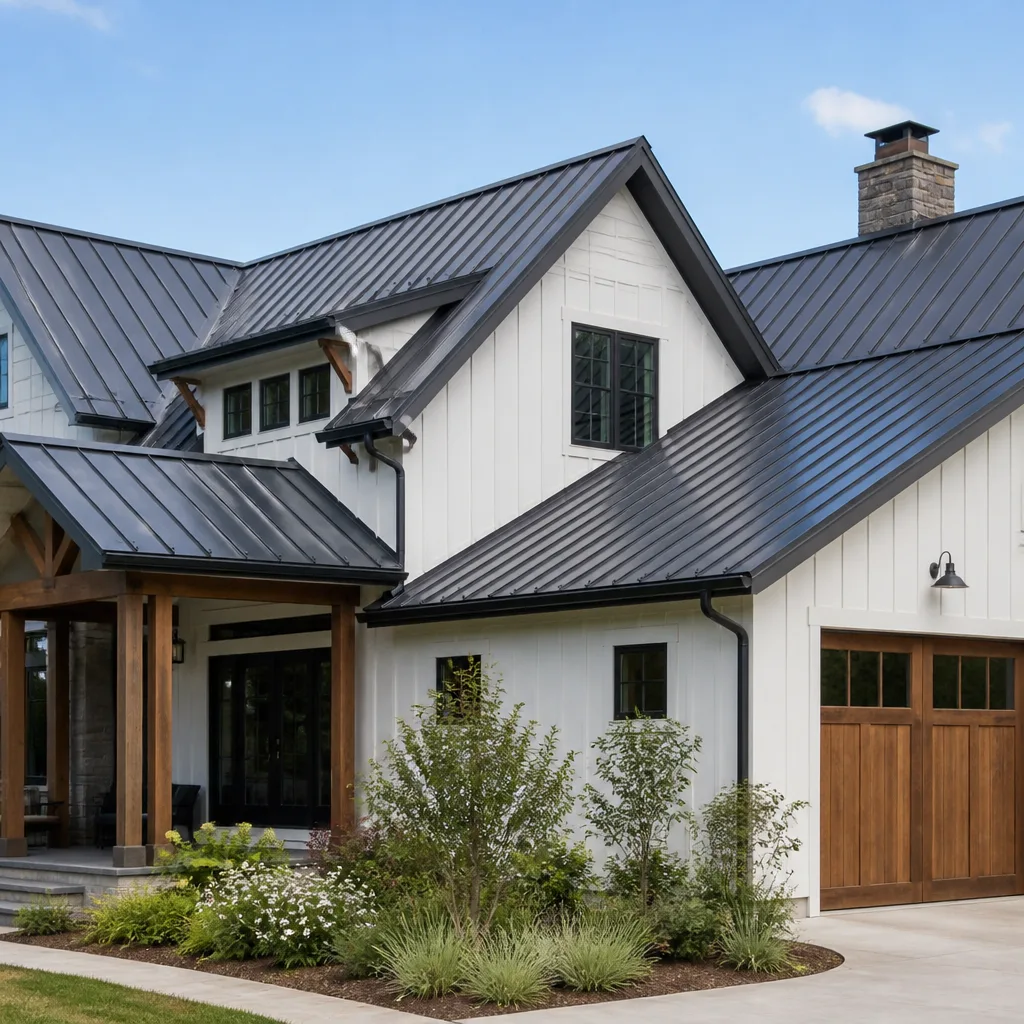 Metal roofing
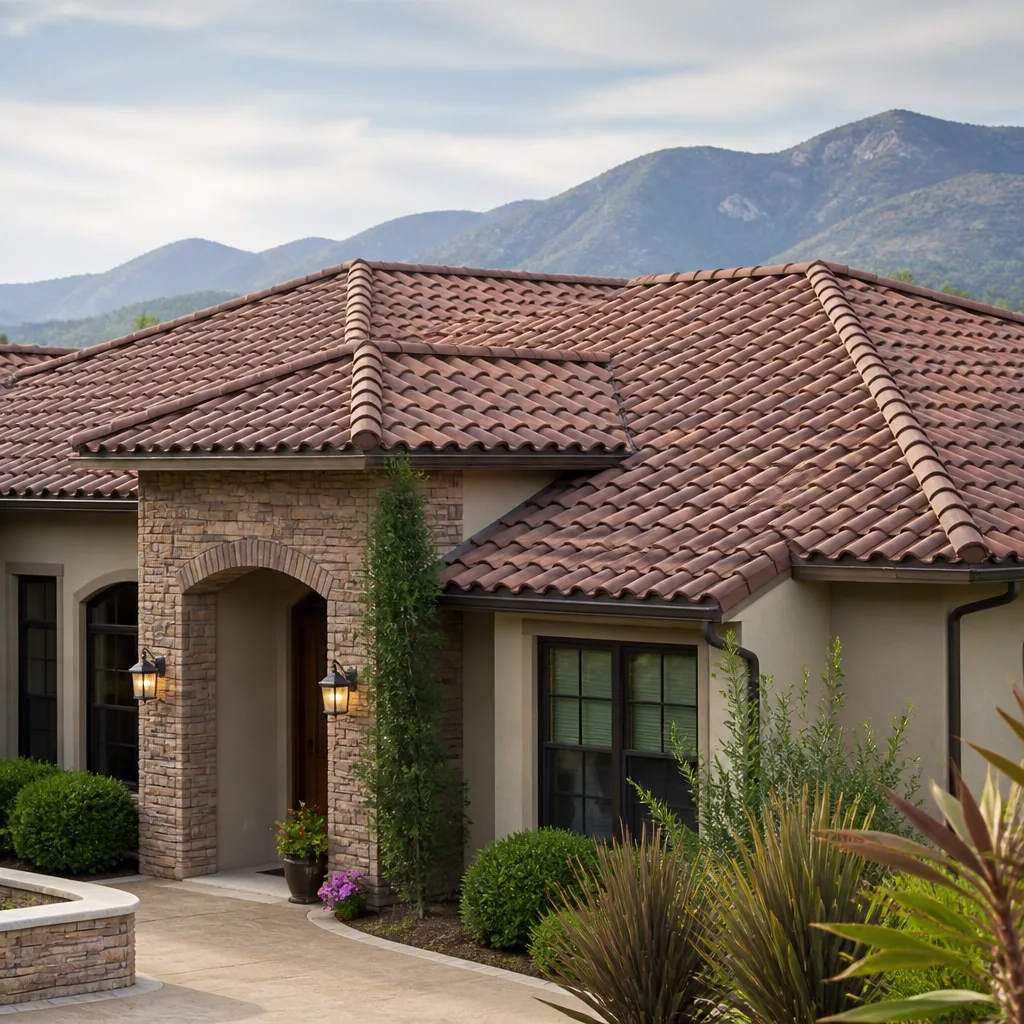 Tile roofing
 GAF
 Owens Corning
 Flat & low-slope
Free roof inspection with deck photos before we talk money - GAF and Owens Corning certified installation
Roof Repair Maintenance Checklist for Inglewood Homeowners
The most damaging maintenance error Inglewood homeowners make isn’t skipping inspections. It’s walking the property after a Santa Ana wind event, seeing no shingles scattered across the lawn, and concluding the roof is fine. Wind damage that eventually causes interior leaks often leaves zero visible evidence at ground level. Lifted shingle seals, loosened ridge cap fasteners, and bent flashing don’t show up from the sidewalk. They fail quietly, months later, during the first heavy rain. This guide is a maintenance checklist built for Inglewood’s actual roof stressors: UV degradation, Santa Ana winds, and episodic heavy rain after long dry spells. You’ll learn what to check, when to check it, and what failure looks like before it becomes a $4,000 ceiling repair.
Styles & brands we work with
Quick Answer
A roof maintenance checklist for Inglewood homeowners should follow three seasonal cycles: post-Santa Ana wind inspections (fall), pre-rain and during-rain checks (December through March), and UV/heat damage monitoring (May through September). The core tasks are: inspect flashing, ridge caps, and shingle seals after every major wind event; clear and test gutters before the first rain; check attic ventilation and visible roof surfaces for UV blistering during summer months. Document everything with photos and notes for insurance and warranty purposes.
Table of Contents
- Inglewood’s Three Roof Stressors: What Actually Damages Roofs Here
- Santa Ana Wind Season Checklist (September – November)
- Rainy Season Checklist (December – March)
- UV and Heat Season Checklist (May – September)
- Gutter and Downspout Guidance for Inglewood’s Episodic Rain Pattern
- How to Identify UV Blistering on Darker Shingles
- The Inglewood Roof Log: A Documentation Template
- Common Mistakes to Avoid
- When to Call a Professional
- Frequently Asked Questions
- The Bottom Line
Inglewood’s Three Roof Stressors: What Actually Damages Roofs Here
Most roofing maintenance checklists circulating online are written for Minneapolis or Chicago. They obsess over ice dams, snow load, and freeze-thaw cycles. None of that applies to Inglewood. Our roofs fail differently, and if you’re working from a generic checklist, you’re looking for the wrong problems.
Inglewood sits in a Mediterranean climate with three distinct roof-damage patterns. First is UV radiation. We get roughly 280 sunny days per year, and that relentless exposure breaks down asphalt shingle binders faster than any storm. Second is Santa Ana wind. Those hot, dry, gusting northeast winds arrive every fall and routinely hit 40 to 60 mph in exposed neighborhoods like Ladera Heights and the flats near the Forum. They don’t rip roofs off. They do something sneakier: they break the adhesive seal between shingle layers and loosen fasteners, creating thousands of micro-openings that fail later. Third is episodic heavy rain. Inglewood gets most of its annual rainfall in a handful of intense events between December and March. That means gutters sit dry and collecting debris for eight months, then get slammed with a season’s worth of water in 48 hours.
Understanding these three stressors changes how you should maintain your roof. You’re not doing seasonal “upkeep.” You’re doing targeted post-event inspection and pre-event preparation. If you want a deeper look at how these local conditions affect repair decisions, our Roof Repair in Inglewood page covers the specific failure modes we see most often.
Santa Ana Wind Season Checklist (September – November)
Santa Ana season is Inglewood’s hurricane season without the hurricane. The winds arrive with little warning, blow for one to three days, and then vanish. The damage they leave behind is rarely obvious from the ground. Here’s the checklist to run after every major wind event, or at minimum once in October and once in November.
After-Each-Wind-Event Checklist
- Walk the full perimeter. Look up at the roof line. Check for shingles that appear lifted, curled, or out of alignment. Pay closest attention to the windward-facing slopes (typically the north and east sides during Santa Anas).
- Inspect the ridge cap. The ridge cap is the row of shingles running along the peak. Wind hits this area hardest. If any cap shingles are shifted, cracked, or missing, water entry is a matter of when, not if.
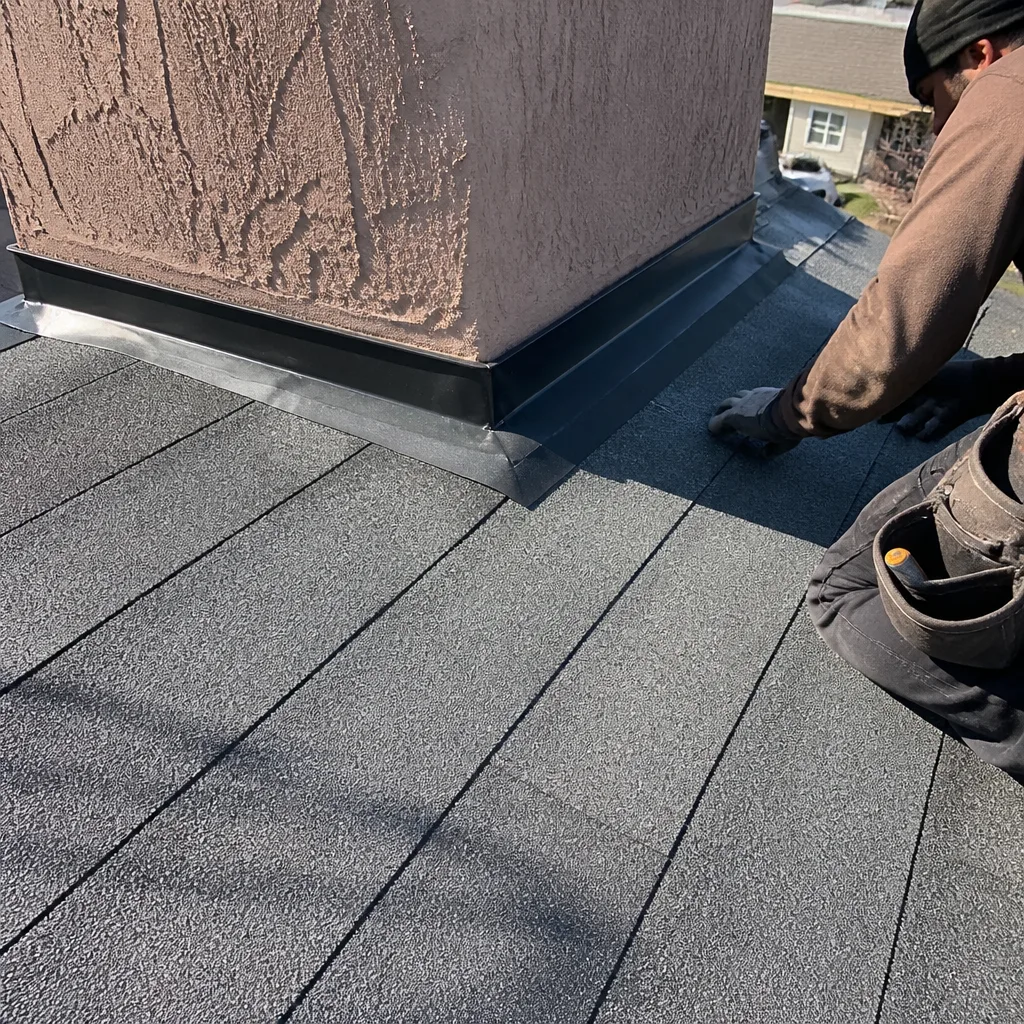
- Check all flashing points. Flashing is the metal material around chimneys, vents, skylights, and where roof slopes meet walls. Wind can bend flashing upward or pull it loose from its sealant. Run your hand along edges if you can reach them safely from a ladder. Look for gaps, lifted corners, or dried-out sealant.
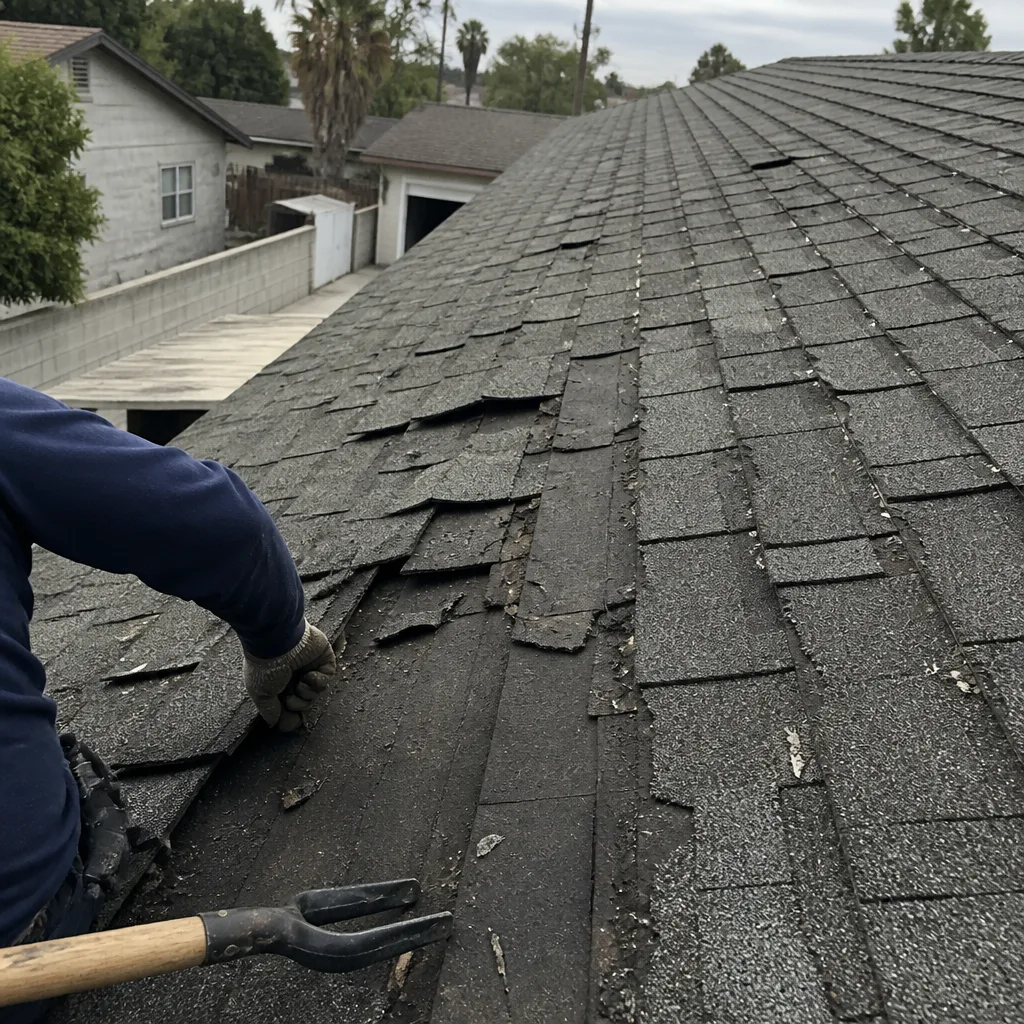
- Examine shingle seals. Asphalt shingles have adhesive strips that bond each layer to the one below. High wind breaks that bond. A shingle can look perfectly flat from the ground but be completely unsealed. The test is to gently lift the edge of shingles on wind-exposed slopes. If it lifts without resistance, the seal is broken.
- Clear debris immediately. Wind deposits leaves, twigs, and sometimes palm fronds into valleys and behind chimneys. Debris traps moisture against the shingle surface and accelerates granule loss. Remove it within 48 hours.
- Photograph everything. Even if nothing looks wrong, take photos of the roof from all four sides. If a problem develops later, those photos establish a timeline. They’re also useful for insurance documentation.
What Most Homeowners Miss
The critical failure most Inglewood homeowners never catch is the ridge cap fastener problem. Ridge cap shingles are secured with nails and sealant, not just the adhesive strips used on field shingles. Wind vibration loosens those nails over time. The cap can look perfectly seated from the ground, but a loose nail means wind-driven rain can get underneath. We’ve inspected roofs in the Morningside Park neighborhood after Santa Ana events where every field shingle was intact and three ridge cap shingles were hanging by a thread. Months later, water showed up in the living room ceiling. The homeowner assumed it was a new leak from the rainy season. It wasn’t. It was a Santa Ana wind event from October that finally let water through in January.
If you’re not comfortable on a ladder, a professional Roof Inspection in Inglewood is the safer route. But if you can access the roof safely, this checklist takes about 30 minutes and can prevent most wind-related failures.
Rainy Season Checklist (December – March)
Inglewood’s rainy season is short but intense. We get an average of 14 inches of rain per year, and most of it falls in four to six significant storm events. That concentration pattern means your roof has to handle a lot of water in a short window, after sitting dry for eight months. Here’s the maintenance rhythm for the wet months.
Before the First Rain (Late November/Early December)
- Clear all gutters and downspouts. This is the single highest-value task on this entire guide. More on the specifics in the gutter section below.
- Check attic for existing stains. Go into the attic on a dry day with a flashlight. Look for dark stains on the underside of the roof decking, water marks along rafters, or any sign of moisture. Stains that are dry now tell you where water got in during a previous season. Those are your vulnerable points.
- Inspect bathroom and kitchen vent boots. These rubber or plastic fittings around vent pipes crack and dry-rot in our sun. A cracked vent boot is one of the most common sources of Inglewood roof leaks, and it’s a $15 part that causes thousands in ceiling damage if ignored.
- Test downspout flow. Run a hose into the gutter for a few minutes and confirm water exits the downspout away from the foundation. Blocked downspouts send water back up under the shingle edge.
During the Rainy Season
- Check the attic during or immediately after the first heavy rain. This is the highest-value diagnostic action you can take. If water is getting in anywhere, you’ll see it as active moisture, not just old stains. Bring a flashlight and look for glistening spots, drips, or wet insulation.
- Watch for shingle “washout.” After heavy rain, walk the perimeter and look at the ground near downspouts. If you see granules collecting, that’s a sign of advancing shingle wear. A small amount is normal for older roofs. A heavy accumulation after a single storm means the shingles are shedding protective material too fast.
- Check for “curling at the eaves.” The bottom edge of the roof gets the most water volume during rain. Shingles near the gutters that are curling, cracking, or losing granules should be flagged for repair before the next storm cycle.
If you discover active water intrusion during a storm, the priority is to contain the interior damage first: move items, place buckets, and call for repair before the next storm. If you need a full replacement rather than a patch, our Roof Replacement in Inglewood page walks through material options across seven manufacturer brands.
UV and Heat Season Checklist (May – September)
Inglewood’s summer is when the roof works hardest without any help from rain. Daytime temperatures in the 80s and 90s send roof surface temperatures well past 150°F. That heat, combined with near-constant UV exposure, breaks down asphalt shingle compounds at the molecular level. Here’s the warm-season checklist.
Quarterly UV Damage Walkthrough
- Look for granule loss. The small granules on asphalt shingles are the UV protection layer. Once they shed, the asphalt below begins to break down rapidly. Check gutters for granule accumulation. If you can see bare patches on shingles where the surface looks shiny or black, UV damage is advanced.
- Identify curling or cupping. Heat causes shingle edges to lift. Curling shingles are a sign that the shingle is nearing the end of its effective life. The longer you wait, the more likely wind gets under that curl and tears the shingle off entirely.
- Check for “fishmouthing.” This is a specific failure pattern where the center of a shingle lifts while the edges stay down. It’s caused by a combination of heat, age, and sometimes fastener problems. Fishmouthing creates channels for wind-driven rain to enter.
- Inspect attic ventilation. Inglewood attics get brutally hot. Poor ventilation raises attic temperatures to 160°F or higher, which bakes the shingles from below and shortens their lifespan dramatically. Check that ridge vents, soffit vents, and gable vents are unobstructed. If you can’t comfortably stay in the attic for five minutes on a summer afternoon, your ventilation is inadequate.
- Check for thermal splitting. This typically appears on the south and west-facing slopes, which get the most sun. Thermal splitting shows up as cracks running vertically through shingles. Unlike wind damage, which is localized, thermal splitting tends to affect entire slopes. If you see it on one part of the roof, expect it elsewhere.
Why This Matters for Inglewood Specifically
Coastal cities like Santa Monica deal with moisture-driven erosion: constant marine layer humidity, salt air, and moss growth. Inglewood is far enough inland that the dominant damage mode is thermal and UV. This matters because the repair strategy is different. Erosion repairs often involve spot replacement. UV damage tends to be systemic: by the time you see it on one shingle, the entire south slope is compromised. That doesn’t mean immediate full replacement. It means a professional evaluation to determine how much life the roof has left, and whether targeted repair can buy you time. At Chatham Roof Repair, we’ve worked on Inglewood roofs where two or three years of proactive warm-season monitoring and minor repairs added a decade to the roof’s life. The key is catching the damage before it converts into leaks.
Gutter and Downspout Guidance for Inglewood’s Episodic Rain Pattern
Gutters in Inglewood behave differently than gutters in regions with regular rainfall. In Chicago, gutters get tested every week. They stay relatively clear because rain flushes them continuously. In Inglewood, gutters sit dry for eight months, collecting leaves, dust, pollen, and the fine particulate matter that blows in on Santa Ana winds. That debris bakes in the sun, compacts, and forms a dense mat. When the December rain finally arrives, water hits that mat and has nowhere to go.
The result is overflow damage: water spills over the gutter edge, runs down the fascia, and seeps behind the shingle drip edge. We’ve seen this pattern repeatedly across Inglewood neighborhoods. The homeowner swears the roof is leaking. The roof is fine. The gutters are the problem.
A Maintenance Rhythm for Dry-Climate Gutters
- September: Clear all gutters before Santa Ana season. Wind will deposit leaves and debris through the fall. Starting with clean gutters gives you a baseline.
- November: Clear gutters again after the last major Santa Ana event, before the first rain. This is the critical cleaning. If you only clean gutters once per year, make it this one.
- January: Check gutters mid-season. After the first significant rain, water should flow freely. If you notice overflow during a storm, the downspout is likely blocked.
- April: Final cleaning of the season, after the last rain. This removes whatever blew in during winter storms and keeps debris from baking into the gutter troughs over the summer.
If your downspouts drain against the foundation rather than away from it, add downspout extensions. Water pooling at the foundation in Inglewood’s clay-heavy soil causes slab movement and foundation cracks over time. A $15 extension from any hardware store prevents a $15,000 foundation repair.
How to Identify UV Blistering on Darker Shingles
UV blistering is the most systematically undertreated roof failure in Inglewood. It’s not mentioned in most maintenance guides, and because it’s slow-moving and hard to see from the ground, it advances for years before anyone notices. Here’s how to spot it.
UV blistering appears as small, raised bumps on the shingle surface. They look like tiny bubbles, usually between the size of a pinhead and a pea. The blisters form when heat and UV radiation break down the asphalt binder inside the shingle, creating gas pockets that push upward through the material. Once the blister pops, it leaves a small crater in the shingle surface, exposing the underlying material to even faster degradation.
Darker shingles are more susceptible because they absorb more solar energy. Black, dark brown, and dark gray shingles routinely hit surface temperatures 20 to 30 degrees hotter than lighter equivalents. That’s the reason Inglewood roofs with dark shingles fail noticeably faster on south-facing slopes.
How to Check for Blistering
- Use the right light. Blistering is easiest to see in low-angle light, early morning or late afternoon. Midday sun flattens the texture and hides the bumps.
- Look at the south slope first. This is where UV exposure is highest. If blistering exists anywhere, it’ll show up there first.
- Inspect from the roof or with binoculars. From the ground, blistering is nearly invisible. A ladder inspection or a pair of binoculars with a steady hand works better.
- Check granule condition. Blistered shingles often shed granules faster than intact ones. Check gutters for granule buildup and look for patches where the shingle surface looks “bald” compared to surrounding areas.
- Compare slopes. Look at the north-facing slope (which gets far less UV exposure) and the south-facing slope on the same roof. If the south slope looks faded, blistered, or granule-depleted compared to the north, you have UV degradation in progress.
If you catch blistering early, the repair options are straightforward: replace the affected shingles before the blisters pop and become water entry points. If the blistering is widespread across multiple slopes, the roof may be approaching the end of its functional life. The material choice matters here. Some manufacturers formulate shingles with higher UV resistance and different granule compositions. At Chatham Roof Repair, we work with products from GAF, CertainTeed, Owens Corning, and Boral, among others, and can match a repair patch to an existing roof in profile, color, and warranty class. That matching matters: a mismatched patch looks bad, and in some cases, using a shingle outside the original manufacturer’s line can complicate warranty coverage on the rest of the roof.
The Inglewood Roof Log: A Documentation Template
Insurance claims and warranty claims both run on documentation. If you can show a pattern of regular maintenance and documented observations over time, claims process faster and face less scrutiny. If you can’t, you’re relying on the adjuster’s goodwill. Here’s the simple log format we recommend for every Inglewood homeowner.
What to Log
- Date and type of event: Santa Ana wind event, heavy rain, summer heat wave, or scheduled inspection.
- Weather conditions: Wind speed if known, rainfall amount, temperature extremes. This context helps establish causation later.
- Observations: What you saw: lifted shingles, granule buildup, gutter overflow, attic stains, blistering. Be specific about location (“south slope, near the chimney”) rather than general (“some damage”).
- Actions taken: What you did: cleared gutters, scheduled repair, applied sealant, called a roofer.
- Photos: Take photos from the same positions every time. Consistent photo angles make changes obvious over time.
Sample Log Entry
Date: November 2, 2026. Event: Santa Ana wind, gusts estimated 55 mph. Observations: walked perimeter, no missing shingles visible from ground. Climbed ladder to inspect ridge cap: two cap shingles near the east end appear lifted approximately 1/4 inch. Flashing around bathroom vent appears intact. Photos taken from north, south, and east positions. Action: scheduled professional inspection for November 5.
This level of detail takes five minutes per entry. Over the life of a roof, it creates a document that insurance adjusters, home inspectors, and warranty administrators can’t easily dismiss. It also gives you a real picture of how your roof is aging, rather than a vague sense that “it seems fine.”
Common Mistakes to Avoid
- Assuming no visible shingle loss means no wind damage. The most common error we see in Inglewood. Wind damage frequently affects seals and fasteners without removing shingles. The shingles stay put until a later rain event reveals the problem.
- Clearing gutters only after they overflow. By the time you see overflow during a storm, water has already been running under the shingle edge. The damage is done. Clean gutters before the first rain, not in response to it.
- Ignoring dark shingle UV degradation. Inglewood’s sun is relentless, and dark shingles absorb the worst of it. Homeowners routinely overlook south-slope blistering until it converts into leaks. A five-minute warm-season inspection catches it early.
- Treating roof maintenance as a once-a-year spring task. That rhythm works in climates with four predictable seasons. In Inglewood, maintenance has to follow the three actual seasonal threats: wind season, rain season, and UV season. A spring-only checklist misses two-thirds of the risk.
- Skipping attic checks because “the roof looks fine from outside.” The attic is where leaks announce themselves first. If you’re not looking at the underside of the roof deck during and after heavy rain, you’re flying blind.
- Documenting nothing and hoping nothing goes wrong. When a storm does damage your roof, you’ll need evidence. Photos, dated notes, and maintenance records are what turn a denied claim into an approved one.
- Waiting to repair because “it’s just a small problem.” In roofing, small problems compound fast. A lifted shingle becomes a leak. A leak becomes a rotted deck. A rotted deck becomes a structural repair. Early action is always cheaper.
When to Call a Professional
Some tasks on this checklist are safe for a homeowner with a sturdy ladder and good judgment. Others are not. If you see active water intrusion in your attic, call a roofer immediately. If you find that multiple ridge cap shingles are loose, or if flashing shows signs of separation anywhere, get a professional evaluation before the next rain. If you’re noticing granule loss, widespread blistering, or shingles that have started to curl across an entire slope, you need to understand whether repair or replacement is the right call. Chatham Roof Repair offers free estimates in Inglewood. Call (866) 361-1724 to schedule a roof inspection. We’ll tell you what needs attention now, what can wait, and what it’ll cost. No pressure toward a replacement unless the roof actually warrants it.
Frequently Asked Questions
At minimum four times per year, timed to the local seasons: once after Santa Ana season ends (November), once during the rainy season (January), once in early summer (May), and once in late summer (September). After any major wind event over 40 mph, add a post-event walkaround. If you’re not comfortable on a ladder, schedule a professional Roof Inspection in Inglewood once per year and handle the ground-level checks yourself.
Wind damage to shingle seals and ridge caps, followed closely by UV degradation on south-facing slopes. The wind damage is more dangerous because it’s invisible from the ground and doesn’t reveal itself until months later when rain arrives. If you’ve had a Santa Ana season and haven’t had the roof checked, you’re carrying hidden risk.
Minor repairs like a cracked vent boot or a few lifted shingles typically run $250 to $600. Flashing repairs typically land between $400 and $900 depending on location and complexity. More involved repairs, like replacing a section of damaged decking or a full ridge cap replacement, can reach $1,500 to $3,000. These are approximations: the only way to get an accurate number is an inspection. Call (866) 361-1724 for a free estimate.
Only if you have a stable, properly positioned ladder and can access all necessary areas without walking on steep slopes or approaching the roof edge. If your roof has any slope steeper than a 4:12 pitch, stay off it. A fall from a roof causes serious injury. Ground-level and attic checks are safe for most homeowners. The on-roof work is worth hiring out.
The decision comes down to three factors: the age of the roof, the extent of the damage, and the condition of the underlying decking. A roof under 10 years old with localized damage is almost always a repair candidate. A roof over 20 years old with UV degradation across multiple slopes and granule loss throughout likely needs replacement. In between, it depends on what the inspection reveals. That’s the evaluation we do honestly at Chatham Roof Repair: we look for the repair before recommending the replacement. Check out our Roof Replacement in Inglewood page for more detail on when replacement makes sense.
Insurance generally covers sudden, accidental damage, like a tree limb falling on the roof or wind ripping shingles off during a Santa Ana event. It does not cover wear and tear from age, UV degradation, or deferred maintenance. That’s why the documentation log in this guide matters. If you can show a maintenance history and date-stamped evidence that damage occurred at a specific time, your claim is much stronger. If the adjuster sees years of neglect, even a legitimate wind damage claim gets harder to pursue.
The Bottom Line
Inglewood roofs fail on a different schedule than roofs in most of the country. Our threats are wind, sun, and episodic rain, not snow and ice. If your maintenance routine accounts for those three seasonal stressors, you can catch damage before it converts into leaks, and you can extend the life of your roof by years. The core habits are: inspect after Santa Ana events, clean gutters before the first rain, check the attic during and after rain, and monitor south-slope UV damage through summer. Document everything. Call a professional when you find something you can’t safely address. If you need an honest assessment of what your roof actually needs, Chatham Roof Repair home offers free estimates across Inglewood. Call (866) 361-1724 to schedule yours.
Written by the team at Chatham Roof Repair, serving Inglewood since 2016.
See the difference
 Before
 After
 Before
 After
 Before
 After